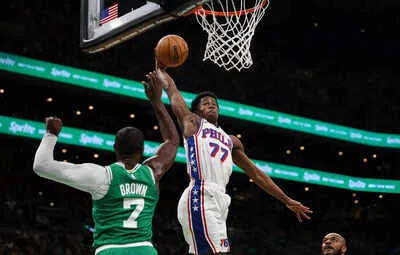
Fans want the 76ers vs Celtics player stats the moment a game ends. The box score is scattered across scoreboards, recap pages, and social posts, and each one lists different numbers. Some show points but skip shooting splits. Others show rebounds but bury the turnovers.
This guide puts every key number in one place. You will find each game’s result, the top performers, the shooting splits that decided the outcome, and the moments that shifted momentum. The stats come from ESPN and CBS Sports box scores.
A Quick Look at the Rivalry
Philadelphia and Boston have met many times in the playoffs, and their games often carry high stakes. The 2026 first-round series pushed both teams into a tight, physical matchup. Jayson Tatum returned from a long injury layoff and carried Boston’s offense early. Tyrese Maxey and Joel Embiid did the same for Philadelphia.
The Series at a Glance
Here is each game’s result and the top scorer for both teams, based on the box scores I could verify.
| Game | Date | Final Score | Top Scorer (Winner) | Top Scorer (Loser) |
| 1 | Apr 19 | Celtics 123, 76ers 91 | Jaylen Brown (26) | Tyrese Maxey (21) |
| 2 | Apr 21 | 76ers 111, Celtics 97 | VJ Edgecombe (30) | Jaylen Brown (36) |
| 3 | Apr 24 | Celtics 108, 76ers 100 | Tyrese Maxey (31) | Jaylen Brown (25) |
| 4 | Apr 26 | Celtics 128, 76ers 96 | Payton Pritchard (32) | Joel Embiid (26) |
| 5 | Apr 28 | 76ers 113, Celtics 97 | Joel Embiid (33) | Jayson Tatum (24) |
Game 1 set the tone. Boston jumped out early and never gave up the lead. Game 2 flipped the script when Philadelphia answered with a balanced scoring night, and the series tied at one game apiece.
The Most Recent Matchup: April 28 Narrative Summary
The most recent game I could confirm was on April 28. Philadelphia won 113-97, and Joel Embiid led the way with 33 points. He made 12 of 23 shots and nine of ten free throws, which showed how much he controlled the paint.
Tatum scored 24 points on 8 of 19 shooting. His efficiency dipped, but he still kept Boston within reach. The 76ers shot 50 percent from the field, far better than the 40 percent Boston managed. That gap decided the game.
Team Totals and Efficiency Comparison
The April 26 game gives the clearest look at how the two teams differ on the floor. Boston dominated the perimeter that night.
| Team Stat | Celtics | 76ers |
| Final Score | 128 | 96 |
| Field Goals | 42-87 (48.3%) | 33-80 (41.3%) |
| 3-Pointers | 24-53 (45.3%) | 9-30 (30.0%) |
| Free Throws | 20-28 (71.4%) | 21-24 (87.5%) |
| Total Rebounds | 51 | 37 |
| Assists | 28 | 25 |
| Turnovers | 12 | 8 |
| Blocks | 5 | 7 |
Boston’s 24 made threes did most of the damage. Philadelphia actually took fewer shots and committed fewer turnovers, but it could not match Boston from deep. Those missed threes allowed Boston to pull away in the third quarter, when it outscored Philadelphia 39-36.
Complete Quarterback-Style Breakdown: Top Playmakers and Passing Stats
Basketball has no quarterback, but the playmaking role belongs to the point guard and the primary creator. For this series, that means Tyrese Maxey for Philadelphia and Jayson Tatum for Boston.
| Player | Game | Points | Rebounds | Assists | Shooting |
| Jayson Tatum | Apr 26 | 30 | 7 | 11 | 8-16 FG, 5-10 3PT |
| Jayson Tatum | Apr 28 | 24 | n/a | n/a | 8-19 FG |
| Tyrese Maxey | Apr 24 | 31 | n/a | n/a | 12-31 FG |
| Tyrese Maxey | Apr 21 | 29 | 4 | 9 | n/a |
Tatum’s 11 assists against Philadelphia on April 26 show his value beyond scoring. He ran the offense while Pritchard finished the job from the outside.
Rushing Leaders and Ground Game Performance
Basketball has no rushing game, so this section covers the ground game in a different sense: the paint and transition scoring. Embiid’s dominance inside shaped Philadelphia’s best nights.
On April 28, Embiid made nine of ten free throws. That free-throw work kept Philadelphia’s offense steady when its perimeter shooting faded. Boston, meanwhile, relied on quick transition baskets to keep pace in the earlier games.
Receiving Production and Target Breakdown: Scoring Options
Each team spreads its offense across several players. Boston’s scoring depends on Brown, Tatum, and Pritchard. Philadelphia leans on Maxey, Embiid, and VJ Edgecombe.
Edgecombe stood out in Game 2 with 30 points and 10 rebounds, even after a hard fall early in the game. His production gave Philadelphia a second scoring threat beside Maxey. Pritchard’s 32-point night in Game 4 showed how quickly a bench contributor can change a series.
Defensive Plays, Turnovers, and Sacks: Key Stops
Basketball does not track sacks or tackles, but defensive stats still tell the story. Rebounds, steals, blocks, and turnovers show who controlled possessions.
In Game 4, Philadelphia recorded seven blocks to Boston’s five. Boston, however, grabbed 37 defensive rebounds to Philadelphia’s 24. Those extra possessions gave Boston second chances and fueled its runs. Turnovers also mattered. Boston committed 12 in Game 4, while Philadelphia committed eight, which kept the 76ers in the game longer than the scoreboard suggested.
Step-by-Step Game-Changing Moments
These turning points shifted the momentum of the series.
Game 1, April 19: Boston took control early and built a lead that Philadelphia never closed. Tatum returned from his Achilles injury with 25 points and 11 rebounds.
Game 2, April 21: Philadelphia tied the series with Edgecombe and Maxey leading a balanced attack. Brown scored 36 for Boston, but the 76ers got contributions across the roster.
Game 3, April 24: Boston won 108-100 behind 25-point games from both Tatum and Brown. Maxey scored 31, but Philadelphia could not stop Boston’s late run.
Game 4, April 26: Boston took a 3-1 series lead. Embiid returned from an appendectomy and scored 26, but Pritchard’s six made threes and 32 points made the difference.
Game 5, April 28: Embiid’s 33-point performance kept Philadelphia alive. He shot nine of ten from the free-throw line, and the 76ers outshot Boston 50 percent to 40 percent.
What the Numbers Tell Us About Each Team
Boston’s strength is its three-point shooting. When the Celtics hit at a high rate from deep, they beat Philadelphia comfortably. Their weakness shows up in games where the outside shots stop falling.
Philadelphia relies on Embiid’s interior scoring and Maxey’s ability to create offense. The 76ers lose ground when Maxey struggles to get his own shot. Their best games come when Embiid, Maxey, and Edgecombe all score in double figures.
Looking Back: How the Rivalry Has Unfolded Over Time
The Celtics and 76ers have a long playoff history. Earlier series featured many of the same storylines: star power, physical defense, and close finishes. The 2026 matchup continues that pattern. Both teams have made recent playoff runs, so each game carries weight beyond the single result.
Why Player Stats Matter in This Matchup
Scoring totals alone do not explain these games. Shooting efficiency, turnovers, and free-throw rates show why one team won and the other lost. Pritchard scored 32 points in Game 4, but he needed 21 shots to do it. Embiid scored 33 in Game 5 on 23 shots, a more efficient night. Looking at the splits reveals how each player affected the outcome.
Final Thoughts and Fan Community Takeaways
If you want the fastest path to the latest 76ers vs Celtics player stats, check the official box score on ESPN or CBS Sports right after each final buzzer. Compare the shooting splits and turnover totals, not just the points. Those numbers reveal which team controlled the game and which players made the biggest impact.