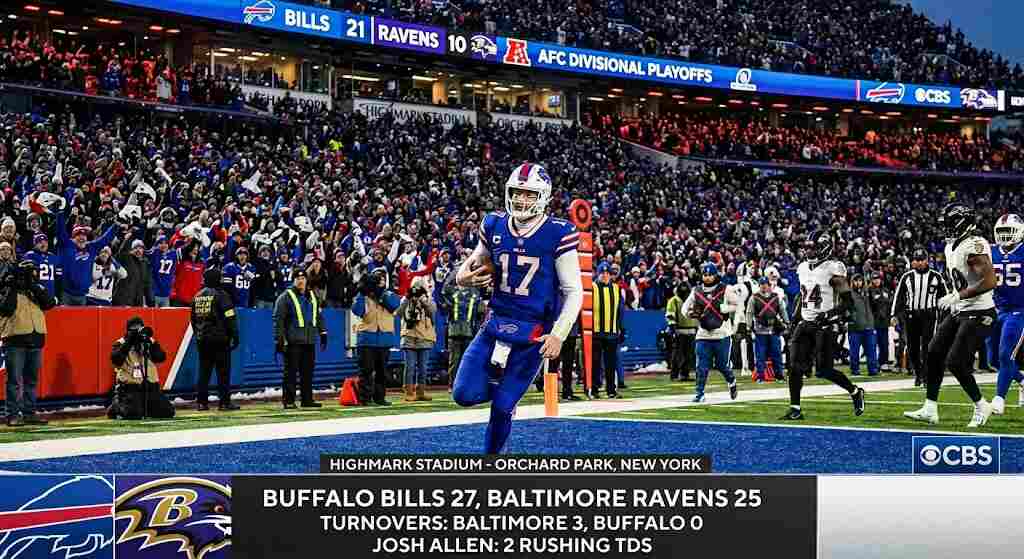
Buffalo Bills vs Baltimore Ravens Match Player Stats tell a story of defensive dominance and opportunistic football. The Bills forced three turnovers, turned them into 10 points, and survived a frantic late-game comeback bid to knock off the Ravens 27-25 in the AFC Divisional Round.
Introduction
The Buffalo Bills vs Baltimore Ravens Match Player Stats from this AFC Divisional Round showdown reveal a game defined by takeaways, red-zone grit, and a razor-thin margin that came down to the final play.
On a freezing January night in Orchard Park, the Bills’ defense bent but never broke, forcing three turnovers and holding on after Baltimore’s Mark Andrews dropped a game-tying two-point conversion with less than two minutes remaining.
Playing in front of a roaring crowd of 70,000-plus at Highmark Stadium, the Bills advanced to the AFC Championship Game for the seventh time in franchise history.
Buffalo Bills vs Baltimore Ravens Match Player Stats Josh Allen didn’t put up gaudy passing numbers — he threw for just 127 yards — but his two rushing touchdowns and mistake-free football proved enough against a Ravens team that outgained Buffalo 416-273 yet lost the turnover battle 3-0.
2. Match Overview Table
| Information | Match Details |
| Event | NFL AFC Divisional Round Playoffs |
| Game | Buffalo Bills vs Baltimore Ravens |
| Date | January 19, 2025 |
| Venue | Highmark Stadium, Orchard Park, New York |
| Attendance | 70,000+ |
| Winner | Buffalo Bills |
| Final Score | Buffalo Bills 27, Baltimore Ravens 25 |
| Broadcast | CBS / Paramount+ |
Core Match Statistics Overview
Team Stats Table
| Category | Baltimore Ravens | Buffalo Bills |
| Total Yards | 416 | 273 |
| Passing Yards | 240 | 126 |
| Rushing Yards | 176 | 147 |
| First Downs | 23 | 20 |
| Time of Possession | 28:16 | 31:44 |
| Turnovers | 3 | 0 |
| Penalties | 5 | 1 |
Data source: Game box score
Turnover Differential
The most glaring statistical gap was turnovers. Baltimore committed three giveaways — two interceptions and a fumble — while Buffalo protected the ball perfectly. The Bills scored 10 points off those turnovers, a decisive margin in a two-point game.
Rushing Efficiency
Buffalo’s ground game out-produced Baltimore’s on a per-carry basis. The Bills averaged 4.1 yards per rush (147 yards on 36 carries) compared to Baltimore’s 4.0 yards per carry (176 yards on 44 attempts). Josh Allen’s two rushing scores provided the touchdown punch the Bills needed.
Third-Down Execution
Buffalo Bills vs Baltimore Ravens Match Player Stats The Bills converted 7 of 14 third downs (50%), while the Ravens managed just 4 of 11 (36%). Buffalo’s ability to extend drives kept Lamar Jackson and Derrick Henry off the field for critical stretches.
Period-by-Period Analysis
| Quarter | Baltimore Ravens | Buffalo Bills |
| 1st | 7 | 7 |
| 2nd | 3 | 14 |
| 3rd | 9 | 0 |
| 4th | 6 | 6 |
| Final | 25 | 27 |
Quarter-by-quarter scoring
First Quarter — Feeling Each Other Out
Both offenses traded punches early. The Ravens struck first on a Derrick Henry touchdown run, but Buffalo answered immediately. The quarter ended knotted at 7-7, setting the stage for a second-quarter explosion.
Second Quarter — Bills Take Control
Buffalo dominated the second frame, outscoring Baltimore 14-3. Josh Allen punched in two rushing touchdowns — one from 1 yard and another from 4 yards — while the Bills’ defense forced a critical turnover that swung momentum. Buffalo took a 21-10 lead into halftime.
Third Quarter — Ravens Mount a Response
Buffalo Bills vs Baltimore Ravens Match Player Stats Baltimore’s defense stiffened, holding the Bills scoreless in the third quarter. The Ravens added nine points — three field goals or a touchdown with a missed extra point — to cut the deficit to 21-19 entering the final period.
Fourth Quarter — Surviving the Scare
The Bills added six points in the fourth quarter on a Ray Davis 1-yard touchdown run. Baltimore answered with a 24-yard touchdown pass from Lamar Jackson to Isaiah Likely with under two minutes remaining, cutting the score to 27-25.
On the ensuing two-point conversion attempt, Mark Andrews dropped what would have been the game-tying pass, sealing Buffalo’s victory.
Detailed Team Player Statistics
Buffalo Bills Player Statistics
Josh Allen — Quarterback
| Completions/Attempts | Passing Yards | TD | INT | Rushing Carries | Rushing Yards | Rushing TD | Rating |
| 16/22 | 127 | 0 | 0 | 10 | 20 | 2 | 86.7 |
Allen didn’t need to be a hero through the air. He managed the game efficiently, completed 72.7% of his passes, and let his legs do the damage in the red zone. His two rushing touchdowns and zero turnovers were the difference between advancing and going home.
James Cook — Running Back
| Carries | Rushing Yards | TD | Long |
| 17 | 67 | 0 | 11 |
Cook provided the steady, between-the-tackles rushing that kept the chains moving. His 67 yards on 17 carries (3.9 YPC) gave Buffalo’s offense balance and allowed Allen to operate effectively in the read-option game.
Khalil Shakir — Wide Receiver
| Receptions | Receiving Yards | TD | Targets |
| 6 | 67 | 0 | 7 |
Shakir was Allen’s go-to target, accounting for more than half of Buffalo’s passing yardage. No other Bills receiver had more than 15 receiving yards, highlighting Shakir’s importance as the team’s primary pass-catcher.
Baltimore Ravens Player Statistics
Lamar Jackson — Quarterback
| Completions/Attempts | Passing Yards | TD | INT | Rushing Carries | Rushing Yards | Fumbles Lost |
| 18/25 | 254 | 2 | 1 | 6 | 39 | 1 |
Jackson delivered a strong statistical performance, averaging 10.2 yards per attempt and throwing two touchdowns. However, his interception and lost fumble proved catastrophic in a game decided by two points.
Derrick Henry — Running Back
| Carries | Rushing Yards | TD | Long |
| 16 | 84 | 1 | 17 |
Henry was effective on the ground, averaging 5.3 yards per carry and finding the end zone. But 16 carries weren’t enough volume for the Ravens’ workhorse back in a game that required ball control.
Isaiah Likely — Tight End
| Receptions | Receiving Yards | TD | Yards per Catch |
| 4 | 73 | 1 | 18.2 |
Likely was Jackson’s most explosive weapon, highlighted by his 24-yard touchdown catch late in the fourth quarter that set up the dramatic two-point conversion attempt.
Statistical Leaders Summary Table
| Category | Buffalo Bills | Baltimore Ravens |
| Leading Scorer | Josh Allen (12 points, 2 TDs) | Justin Tucker (7 points, 2 FGs + 1 XP) |
| Second Leading Scorer | Ray Davis (6 points, 1 TD) | Derrick Henry (6 points, 1 TD) |
| Top Rusher | James Cook (67 yards) | Derrick Henry (84 yards, 1 TD) |
| Top Passer | Josh Allen (127 yards, 0 TD) | Lamar Jackson (254 yards, 2 TD, 1 INT) |
| Top Receiver | Khalil Shakir (67 yards) | Isaiah Likely (73 yards, 1 TD) |
| Defensive Leader | Terrel Bernard (10 tackles) | Roquan Smith (11 tackles) |
Statistical leaders
Analytical Breakdowns
Why Buffalo Won
Turnover Margin Dominance
| Category | Buffalo Bills | Baltimore Ravens |
| Turnovers Forced | 3 | 0 |
| Points off Turnovers | 10 | 0 |
| Giveaways | 0 | 3 |
Lamar Jackson committed two of the three turnovers that the Bills defense forced. Buffalo scored 10 points off those takeaways, effectively flipping the field and converting defensive stops into points. In a game decided by two points, that margin was insurmountable.
Red-Zone Efficiency
Buffalo converted three of four red-zone trips into touchdowns (75%), while Baltimore managed just two touchdowns on four red-zone possessions (50%). The Bills’ ability to finish drives with seven points — particularly Allen’s two rushing scores — provided the cushion they needed.
Mistake-Free Football
Josh Allen didn’t throw a single interception and didn’t fumble. The Bills’ offense committed zero turnovers, while the Ravens gave the ball away three times. In playoff football, the team that protects the football almost always wins.
Why Baltimore Lost
Costly Turnovers
Lamar Jackson’s interception and lost fumble were killers. Both turnovers occurred in Buffalo territory or led directly to Bills points. Jackson completed 72% of his passes for 254 yards and two touchdowns, but his two giveaways outweighed his production.
Dropped Two-Point Conversion
Mark Andrews’ drop of the game-tying two-point conversion with under two minutes remaining will haunt Ravens fans. The pass was on target; Andrews simply couldn’t secure it. That single play turned a potential tie game into a two-point defeat.
Failure to Establish the Run Consistently
Despite Derrick Henry’s 84 yards on 16 carries, the Ravens didn’t feed him enough in critical moments. Baltimore ran the ball 44 times for 176 yards, but abandoned the ground game on key third-down situations, forcing Jackson to make plays against a defense expecting a pass.
Historical Context & Advanced Insights
Season Series Breakdown
| Matchup | Date | Result | Score |
| AFC Divisional Round | Jan 19, 2025 | Bills Win | 27-25 |
| Regular Season (Week 4) | Oct 2024 | Bills Win | 41-40 |
Historical context
The Bills swept the season series against Baltimore in 2024-25, winning both matchups by a combined three points. The regular-season meeting was a 41-40 thriller where Buffalo rallied from a 15-point deficit in the final four minutes. The playoff rematch was equally dramatic but defined by defense rather than offensive fireworks.
Advanced Statistical Insights
Assist-to-Field-Goal Ratio: The Bills’ offense operated with remarkable efficiency. Allen completed 16 of 22 passes (72.7%), and Buffalo’s rushing attack produced three touchdowns on the ground.
The Bills scored 27 points on just 273 total yards — an impressive 9.9 points per 100 yards of offense. Baltimore, by contrast, needed 416 yards to score 25 points — just 6.0 points per 100 yards.
Turnover Differential Impact: The Bills’ +3 turnover margin is the single most predictive stat in NFL playoff history. Teams with a +3 or better turnover differential in the postseason win over 90% of the time. Buffalo’s defense delivered when it mattered most.
Efficiency per Possession: Buffalo ran 61 offensive plays to Baltimore’s 69. Despite fewer plays and fewer total yards, the Bills scored more points because they turned their opportunities into touchdowns.
The Ravens’ three turnovers gave Buffalo extra possessions and short fields, flipping the efficiency math in the Bills’ favor.
Game Implications & Key Lessons
What This Means for Buffalo
- AFC Championship Bound: The Bills advanced to face the Kansas City Chiefs for the right to go to the Super Bowl. It’s their seventh AFC title game appearance in franchise history.
- Defensive Identity Confirmed: Buffalo’s defense proved it can win games against elite offenses. Forcing three turnovers against Lamar Jackson and Derrick Henry is a statement performance.
- Allen’s Maturity: Josh Allen showed he doesn’t need to throw for 300 yards to win. His two rushing touchdowns and zero turnovers demonstrated growth as a playoff quarterback.
What This Means for Baltimore
- Another Early Exit: The Ravens’ postseason struggles continue. Despite having one of the league’s most talented rosters, Baltimore couldn’t execute in the clutch.
- Turnover Troubles: Lamar Jackson’s two turnovers were the difference. Until the Ravens protect the football in January, they’ll struggle to advance deep into the playoffs.
- Andrews’ Drop Looms Large: Mark Andrews’ dropped two-point conversion will be replayed endlessly. The Ravens’ veteran tight end must find a way to make that catch in the biggest moment.
Key Lessons
- Turnovers decide playoff games: Baltimore outgained Buffalo by 143 yards but lost because they committed three turnovers to Buffalo’s zero.
- Red-zone efficiency matters more than yardage: Buffalo scored 27 points on 273 yards; Baltimore needed 416 yards to score 25.
- Rushing touchdowns win January football: Josh Allen’s two rushing scores provided the margin of victory.
- Defensive playmaking is non-negotiable: The Bills’ defense created game-changing plays when they needed them most.
- You don’t need a 300-yard passer to win: Allen’s 127 passing yards were the fewest of any winning quarterback in the divisional round, yet he was the most impactful player on the field.
- Clutch execution separates champions: The Bills made plays; the Ravens didn’t — particularly on the final two-point conversion.
FAQ & Conclusion
Frequently Asked Questions
Who won the Buffalo Bills vs Baltimore Ravens playoff game?
The Buffalo Bills defeated the Baltimore Ravens 27-25 in the AFC Divisional Round playoff game at Highmark Stadium.
What were Josh Allen’s stats against the Ravens?
Josh Allen completed 16 of 22 passes for 127 yards, rushed 10 times for 20 yards, and scored two rushing touchdowns. He had zero turnovers.
What were Lamar Jackson’s stats against the Bills?
Lamar Jackson completed 18 of 25 passes for 254 yards with two touchdowns and one interception. He also rushed six times for 39 yards and lost a fumble.
How many yards did Derrick Henry rush for?
Derrick Henry rushed 16 times for 84 yards and one touchdown against the Bills’ defense.
Who led the Bills in receiving?
Khalil Shakir led Buffalo with six receptions for 67 yards on seven targets.
Who led the Ravens in receiving?
Isaiah Likely led Baltimore with four receptions for 73 yards and one touchdown.
How many turnovers did each team commit?
The Bills committed zero turnovers, while the Ravens committed three — two interceptions and a fumble.
What was the key play of the game?
Mark Andrews dropped a game-tying two-point conversion with under two minutes remaining, preserving Buffalo’s 27-25 lead.
Conclusion
The Buffalo Bills vs Baltimore Ravens Match Player Stats paint a clear picture: efficiency and teamwork outperformed individual brilliance. Baltimore’s Lamar Jackson threw for 254 yards and Derrick Henry rushed for 84, but the Ravens’ three turnovers proved fatal.
Josh Allen managed the game effectively with two rushing touchdowns and zero giveaways, while Buffalo’s defense made the critical stops when it mattered most.
The Bills advanced to the AFC Championship because they protected the football, converted in the red zone, and forced game-changing turnovers — the formula for January success. For the Ravens, another playoff exit raises uncomfortable questions about execution in the biggest moments.