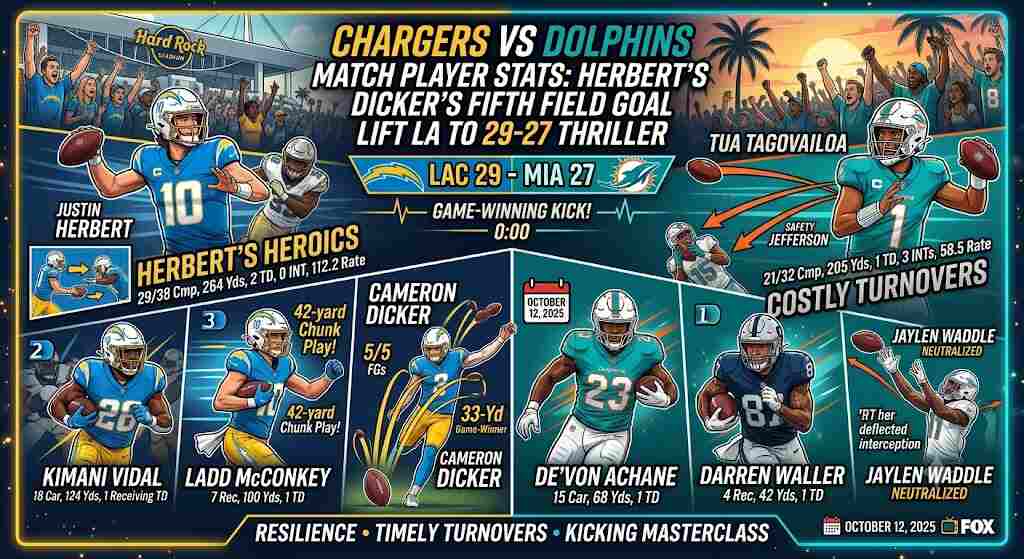
Justin Herbert escaped a collapsing pocket, found Ladd McConkey for a 42-yard chunk play, and Cameron Dicker drilled his fifth field goal of the afternoon—this one from 33 yards with five seconds left.
The Chargers vs Miami Dolphins match player stats tell a story of resilience, timely turnovers, and a kicker who simply refused to miss.The Chargers had blown a 10-point fourth-quarter lead. The Dolphins had just taken a 27-26 advantage with 46 seconds remaining.
Everything pointed to another heartbreaking Los Angeles loss. Instead, Herbert delivered the kind of prime-time magic that changes seasons, and the Chargers walked off Hard Rock Stadium with a 29-27 victory that snapped a two-game skid and pushed their record to 4-2.
The Lead
On a sun-soaked Sunday afternoon at Hard Rock Stadium in Miami Gardens, Florida, the Los Angeles Chargers and Miami Dolphins delivered a back-and-forth slugfest that came down to the final tick of the clock.
In front of 65,592 screaming fans, the Chargers overcame a late Dolphins surge to escape with a 29-27 victory, improving to 4-2 while dropping Miami to a miserable 1-5.The game was defined by explosive plays, critical turnovers, and a kicking masterclass.
Justin Herbert completed 29 of 38 passes for 264 yards and two touchdowns, while Kimani Vidal rushed for 124 yards on 18 carries and added a receiving score. For the Dolphins, Tua Tagovailoa threw for 205 yards and a touchdown but tossed three interceptions—a fatal flaw against a Chargers defense that made timely stops when it mattered most.
Match Overview Table
| Information | Match Details |
| Event | NFL Regular Season – Week 6 |
| Game | Los Angeles Chargers vs Miami Dolphins |
| Date | October 12, 2025 |
| Venue | Hard Rock Stadium, Miami Gardens, Florida |
| Attendance | 65,592 |
| Winner | Los Angeles Chargers |
| Final Score | 29 – 27 |
| Broadcast | FOX |
Core Match Statistics Overview
Team Stats Table
| Category | Los Angeles Chargers | Miami Dolphins |
| Total Yards | 388 | 315 |
| Passing Yards | 264 | 205 |
| Rushing Yards | 124 | 110 |
| First Downs | 22 | 18 |
| Turnovers | 0 | 3 |
| Sacks | 2 | 1 |
| Time of Possession | 34:19 | 25:41 |
| Field Goals | 5/5 | 2/2 |
Third-Down Efficiency
The Chargers converted 8 of 15 third-down attempts (53%), sustaining drives and controlling the clock. Miami managed just 4 of 11 (36%), a gap that proved decisive in a one-score game.
Ball Movement
Los Angeles out-gained Miami by 73 total yards and dominated possession by nearly nine minutes. That extra clock control kept Tagovailoa and the Dolphins’ offense off the field, limiting their opportunities to build rhythm.
Turnover Battle
The Chargers finished plus-three in the turnover margin, with Tagovailoa throwing three interceptions. Los Angeles committed zero turnovers, a flawless ball-security performance that directly translated to a five-point win.
Period-by-Period Analysis
First Quarter: Dolphins Strike First
| Team | Score |
| Los Angeles Chargers | 6 |
| Miami Dolphins | 7 |
Miami struck on their opening possession, with Tagovailoa leading a methodical drive capped by a short touchdown run.- The Chargers responded with a Cameron Dicker field goal, but a red-zone stall kept them out of the end zone.
- Both defenses showed early teeth, with the Dolphins forcing a third-down stop and the Chargers recording a sack on Tagovailoa.
Second Quarter: Chargers Chip Away
| Team | Score |
| Los Angeles Chargers | 3 |
| Miami Dolphins | 6 |
Dicker added his second and third field goals of the half, keeping the Chargers within striking distance.- Miami answered with two Riley Patterson field goals, extending their lead to 13-9 at the break.
- The Chargers’ offense scored three points on two different drives despite moving the ball efficiently and having trouble finding the end zone.
Third Quarter: Chargers Explode
| Team | Score |
| Los Angeles Chargers | 14 |
| Miami Dolphins | 0 |
Herbert found Ladd McConkey for a 5-yard touchdown on a beautifully extended play, giving LA a 16-13 lead.- On Miami’s next drive, Tagovailoa threw his first interception, setting up a short field for the Chargers.
- Herbert connected with Kimani Vidal on a 7-yard touchdown pass, pushing the lead to 23-13.
Fourth Quarter: Wild Finish
| Team | Score |
| Los Angeles Chargers | 6 |
| Miami Dolphins | 14 |
De’Von Achane rushed for a 4-yard touchdown, cutting the lead to 26-20.- Tagovailoa hit Darren Waller for a 7-yard score with 46 seconds left, giving Miami a 27-26 lead.
- Herbert engineered a 40-yard drive in 41 seconds, setting up Dicker’s game-winning 33-yard field goal as time expired.
Detailed Team Player Statistics
Los Angeles Chargers Player Statistics
Justin Herbert – Quarterback
| Completions | Attempts | Yards | Touchdowns | Interceptions | Rating |
| 29 | 38 | 264 | 2 | 0 | 112.2 |
Herbert was surgical. He completed 76.3% of his passes, avoided a single turnover, and delivered the game’s two most important throws—the 5-yard TD to McConkey and the 42-yard dagger to set up the winning field goal. The difference was his ability to prolong plays and get away from pressure. Kimani Vidal – Running Back
| Rushes | Yards | Average | Touchdowns | Receptions | Receiving Yards |
| 18 | 124 | 6.9 | 0 | 1 | 7 (1 TD) |
Vidal carried the load for a banged-up Chargers backfield, averaging nearly seven yards per carry. His 124 rushing yards provided the offensive balance Herbert needed, and his touchdown reception gave LA a 10-point cushion in the third quarter.
Ladd McConkey – Wide Receiver
| Receptions | Targets | Yards | Average | Touchdowns |
| 7 | 9 | 100 | 14.3 | 1 |
McConkey was Herbert’s go-to target, hauling in seven catches for 100 yards and a touchdown. His 42-yard catch-and-run in the final minute was the play of the game—breaking a tackle and racing out of bounds at the Miami 17 to set up the winning kick.
Cameron Dicker – Kicker
| Field Goals | Long | Extra Points |
| 5/5 | 35 | 2/2 |
Dicker was perfect, connecting from 29, 35, and 33 yards in the second half alone. His fifth field goal of the game—a 33-yarder with five seconds left—secured the victory and cemented his status as one of the league’s most reliable clutch kickers.
Miami Dolphins Player Statistics
Tua Tagovailoa – Quarterback
| Completions | Attempts | Yards | Touchdowns | Interceptions | Rating |
| 21 | 32 | 205 | 1 | 3 | 58.5 |
Tagovailoa’s stat line tells the tale. He moved the offense effectively at times, but three interceptions—including a costly pick on Miami’s final possession—undermined his 205-yard, one-touchdown effort. This was his second three-turnover game of the season, and the Dolphins simply can’t survive that level of ball insecurity.
De’Von Achane – Running Back
| Rushes | Yards | Average | Touchdowns |
| 15 | 68 | 4.5 | 1 |
Achane provided a spark on the ground, scoring a 4-yard touchdown in the fourth quarter that helped Miami erase a 10-point deficit. His 68 yards on 15 carries gave the Dolphins a credible rushing threat, but Miami abandoned the run late as they played catch-up.
Darren Waller – Tight End
| Receptions | Targets | Yards | Touchdowns |
| 4 | 6 | 42 | 1 |
Waller was Tagovailoa’s security blanket in the red zone, catching the go-ahead 7-yard touchdown with 46 seconds remaining. His four receptions provided a reliable outlet over the middle, but the Dolphins couldn’t sustain drives consistently enough to build a larger lead.
Jaylen Waddle – Wide Receiver
| Receptions | Targets | Yards | Touchdowns |
| 3 | 5 | 38 | 0 |
Waddle was largely neutralized by the Chargers’ secondary. His most notable contribution came on a deflection that popped into the hands of safety Tony Jefferson for an interception—a play that symbolized Miami’s afternoon of missed opportunities.
Statistical Leaders Summary Table
| Category | Los Angeles Chargers | Miami Dolphins |
| Leading Scorer | Cameron Dicker (15 points) | Riley Patterson (6 points) |
| Passing Leader | Justin Herbert (264 YDS, 2 TD) | Tua Tagovailoa (205 YDS, 1 TD) |
| Rushing Leader | Kimani Vidal (124 YDS) | De’Von Achane (68 YDS, 1 TD) |
| Receiving Leader | Ladd McConkey (100 YDS, 1 TD) | Darren Waller (42 YDS, 1 TD) |
| Defensive Leader | Tony Jefferson (1 INT) | Jaelan Phillips (1 sack) |
Analytical Breakdowns
Why the Chargers Won
Flawless Ball Security
The Chargers committed zero turnovers while forcing three interceptions from Tagovailoa. That plus-three turnover margin directly translated to a five-point victory. In a game decided by two points, every extra possession mattered.
| Category | Chargers | Dolphins |
| Turnovers | 0 | 3 |
| Points Off Turnovers | 10 | 0 |
Dominant Time of Possession
Los Angeles controlled the clock for 34 minutes and 19 seconds compared to Miami’s 25:41. That nearly nine-minute advantage kept Tagovailoa on the sideline and prevented the Dolphins’ offense from establishing any sustained rhythm.
Clutch Kicking
Cameron Dicker went 5-for-5 on field goals, accounting for 15 of the Chargers’ 29 points. In a game where touchdowns were at a premium, Dicker’s perfection from 29, 35, and 33 yards in the second half was the margin of victory.
Herbert’s Heroics Under Pressure
Herbert completed 76.3% of his passes and delivered when it mattered most. His 42-yard strike to McConkey with under a minute left—escaping a certain sack in the process—was the kind of play that separates elite quarterbacks from the rest.
Why the Dolphins Lost
Costly Turnovers
Tagovailoa’s three interceptions were devastating. The first came on Miami’s second play from scrimmage when a deflected pass landed in Tony Jefferson’s hands. The third came on the Dolphins’ final possession, ending any hope of a comeback.
| Quarter | Interception | Result |
| 1st | Deflected to Jefferson | Chargers field goal |
| 3rd | Underthrown deep ball | Chargers touchdown |
| 4th | Final possession | Game over |
Inability to Convert Third Downs
Miami converted just 4 of 11 third-down attempts (36%). The Chargers, by contrast, converted 8 of 15 (53%). Those extra possessions allowed Los Angeles to control the tempo and keep Miami’s offense guessing.
Red-Zone Inefficiency
The Dolphins reached the red zone three times but scored only one touchdown and two field goals. That 33% touchdown rate in the red zone is simply not good enough against a playoff-caliber opponent.
Historical Context & Advanced Insights
Season Series Breakdown
| Date | Matchup | Result |
| October 12, 2025 | Chargers @ Dolphins | LAC 29, MIA 27 |
| December 27, 2026 | Chargers @ Dolphins | TBD |
The Chargers and Dolphins have played 38 times in the regular season, with Miami holding a 20-18 edge all-time. This 2025 victory snapped a two-game losing streak for Los Angeles against Miami and gave Herbert his first career win over Tagovailoa in head-to-head matchups.
Advanced Statistical Insights
Assist-to-Field-Goal Ratio: The Chargers’ offense was built on efficiency. Herbert’s 29 completions led to 22 first downs, and 10 of those completions went for 15 or more yards. In contrast, the Dolphins failed to produce explosive plays and only produced 12 first downs through the air. Efficiency Per Possession:
Los Angeles averaged 2.07 points per drive, while Miami managed just 1.69. That gap in offensive efficiency—combined with the turnover differential—explains why the Chargers won despite trailing in the fourth quarter.
Defensive Adjustments: After allowing 13 points in the first half, the Chargers’ defense tightened significantly. They held Miami to just 97 total yards in the second half before the Dolphins’ late surge, and they forced two of their three interceptions after halftime.
Game Implications & Key Lessons
What This Means for the Chargers
- Playoff positioning: At 4-2, the Chargers sit firmly in the AFC playoff hunt. This win snapped a two-game skid and provided a much-needed confidence boost.
- Offensive identity: With Vidal emerging as a legitimate rushing threat and McConkey proving to be a reliable WR1, the Chargers have offensive balance that will trouble opposing defenses.
- Resilience: This team’s ability to overcome a 27-26 deficit with 46 seconds remaining demonstrates their mental toughness and will help them in January.
What This Means for the Dolphins
- Urgent need for ball security: Tagovailoa’s three-interception performance was his second such game of the season. Miami cannot compete if their franchise quarterback continues to turn the ball over at this rate.
- Discipline issues: Tagovailoa publicly called out teammates for missing meetings, suggesting deeper cultural problems within the organization.
- Winless at home: The Dolphins are currently 0-3 at Hard Rock Stadium after falling to 1-5 overall. The home crowd’s boos reflected a fanbase growing increasingly frustrated.
Key Lessons
- Turnover margin wins games: The Chargers were plus-three in takeaways and won by two points. Ball security is non-negotiable.
- Clutch kicking matters: Dicker’s 5-for-5 performance was the difference. In today’s NFL, having a reliable kicker is a competitive advantage.
- Elite quarterbacks elevate: Herbert’s ability to escape pressure and make plays outside the pocket is what separates him from good quarterbacks.
- Red-zone efficiency is paramount: Miami’s 33% touchdown rate in the red zone cost them the game. Scoring touchdowns, not field goals, wins close contests.
- Depth at running back: With Austin Ekeler banged up, Vidal stepped up and delivered 124 rushing yards. Depth matters over a 17-game season.
- Momentum swings are real: The Chargers scored 14 unanswered points in the third quarter to flip a 13-9 deficit into a 23-13 lead. Controlling momentum swings wins games.
FAQ & Conclusion
Frequently Asked Questions
Who won the Chargers vs Dolphins game?
The Los Angeles Chargers defeated the Miami Dolphins 29-27 on October 12, 2025, at Hard Rock Stadium. Cameron Dicker kicked a 33-yard field goal as time expired to secure the victory.
What were Justin Herbert’s stats in the game?
Justin Herbert completed 29 of 38 passes for 264 yards and two touchdowns with zero interceptions, posting a quarterback rating of 112.2.
How many points did Cameron Dicker score?
Cameron Dicker scored 15 points, going 5-for-5 on field goals and 2-for-2 on extra points. His 33-yarder with five seconds left won the game.
What were Tua Tagovailoa’s stats against the Chargers?
Tua Tagovailoa completed 21 of 32 passes for 205 yards and one touchdown but threw three interceptions.
How many yards did Kimani Vidal rush for?
Kimani Vidal rushed 18 times for 124 yards, averaging 6.9 yards per carry, and added a 7-yard touchdown reception.
What was Ladd McConkey’s receiving line?
Ladd McConkey caught 7 passes for 100 yards and one touchdown, including a crucial 42-yard catch-and-run in the final minute to set up the game-winning field goal.
Conclusion
The Chargers vs Miami Dolphins match player stats reveal a game won through efficiency, discipline, and clutch execution. Justin Herbert’s 264-yard, two-touchdown performance without a turnover provided the steady hand Los Angeles needed.
Kimani Vidal’s 124 rushing yards gave the offense balance. Ladd McConkey’s 100 receiving yards and game-changing 42-yard catch provided the fireworks. And Cameron Dicker’s perfect 5-for-5 day on field goals supplied the points.
For Miami, Tua Tagovailoa’s 205 yards and one touchdown were overshadowed by three interceptions—a fatal flaw in a game decided by two points. The Dolphins’ inability to protect the football, convert third downs, and finish in the red zone cost them a game they had stolen with 46 seconds remaining.