Introduction
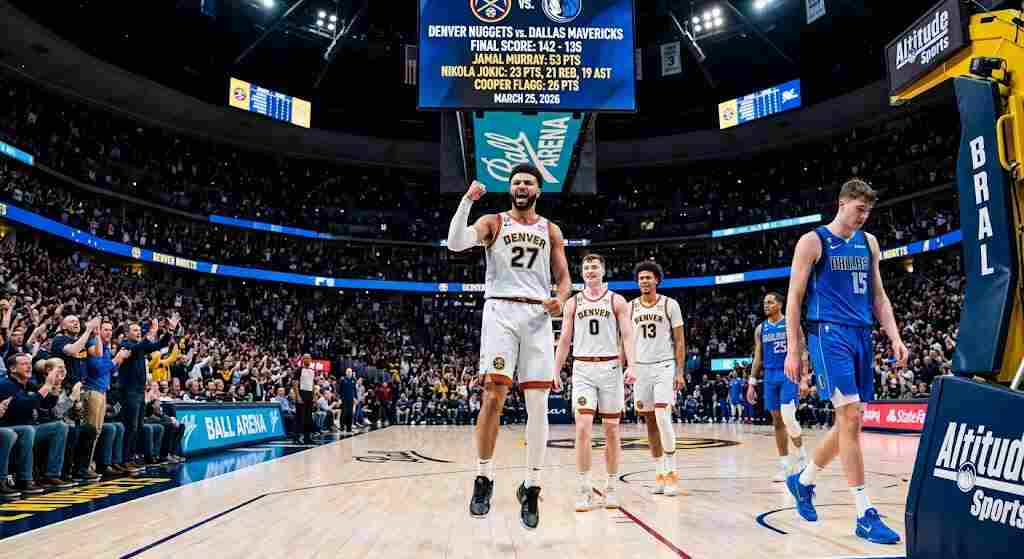
When analyzing Dallas Mavericks vs Denver Nuggets match player stats, one number jumps off the page: 53. Jamal Murray’s season-high scoring outburst powered the Nuggets past a resilient Mavericks squad in a Western Conference shootout that had playoff intensity written all over it.
The Denver Nuggets, behind a historic performance from their backcourt leader and a signature triple-double from Nikola Jokic, outlasted the Dallas Mavericks 142-135 on March 25, 2026, at Ball Arena in front of 19,837 roaring fans.
Dallas fought tooth and nail, cutting the lead to single digits multiple times in the fourth quarter, but Denver’s offensive efficiency—shooting 56% from the field—proved too much for a Mavericks defense that simply had no answers for the two-man game of Murray and Jokic.
Match Overview
| Information | Match Details |
| Event | NBA Regular Season 2025-26 |
| Game | Dallas Mavericks vs Denver Nuggets |
| Date | March 25, 2026 |
| Venue | Ball Arena, Denver, CO |
| Attendance | 19,837 |
| Winner | Denver Nuggets |
| Final Score | 142-135 |
| Broadcast | KFAA-TV, Mavs.com, Altitude Sports, NBA League Pass |
Core Match Statistics Overview
Team Stats Comparison
| Metric | Dallas Mavericks | Denver Nuggets |
| Field Goal % | 49% (48-97) | 56% (50-89) |
| Three Point % | 34% (12-35) | 50% (19-38) |
| Free Throw % | 79% (27-34) | 79% (23-29) |
| Total Rebounds | 42 | 45 |
| Assists | — | — |
| Turnovers | 4 | 9 |
| Largest Lead | 4 | 13 |
| % of Game Led | 17% | 80% |
Three-Point Shooting
- Denver’s perimeter precision was the separator. The Nuggets connected on 19 of 38 attempts from beyond the arc, a scorching 50% clip that consistently stretched Dallas’s defense and created driving lanes.
- Dallas managed just 12 triples on 35 attempts (34%), with the starting lineup combining for only 6 made threes—a glaring disparity in a game decided by seven points.
Ball Movement and Turnovers
- The Mavericks committed only 4 turnovers all game—an exceptional display of ball security. Yet Denver’s offensive firepower simply overwhelmed them despite giving the ball away 9 times.
- Denver’s assist-to-field-goal ratio was elite, with Jokic orchestrating the offense to the tune of 19 assists, many of which led to high-percentage looks.
Free Throw Disparity
- Both teams shot 79% from the stripe, but Dallas attempted significantly more free throws (34 to Denver’s 29). The Mavericks converted 27 of those, keeping them in the game during dry spells from the field.
- Denver’s ability to match Dallas’s free-throw efficiency while shooting a higher volume from three created the mathematical edge.
Period-by-Period Analysis
| Quarter | Dallas Mavericks | Denver Nuggets |
| 1st | 33 | 34 |
| 2nd | 26 | 34 |
| 3rd | 41 | 43 |
| 4th | 35 | 31 |
First Quarter – Trading Blows: Both teams came out firing, combining for 67 points in the opening frame. Denver’s 34-33 edge set the tone for a night of relentless offense, with Murray and Jokic already finding their rhythm.- Second Quarter – Nuggets Pull Away: Denver’s 34-26 advantage in the second period stretched the lead to nine at halftime. The Nuggets’ bench provided crucial minutes, outscoring Dallas’s reserves 39-52 on the night but maintaining defensive intensity while starters rested.
- Third Quarter – Fireworks: Both teams erupted for 41+ points in the third, combining for 84 points in a dizzying 12-minute stretch. Dallas cut into the deficit multiple times, but Denver answered every run with a timely basket, often from Murray or Jokic.
- Fourth Quarter – Dallas Fights Back: The Mavericks outscored Denver 35-31 in the final frame, getting within striking distance on several occasions. However, Denver’s 13-point largest lead proved insurmountable as the Nuggets executed down the stretch.
Detailed Team Player Statistics
Dallas Mavericks Player Statistics
| Player | MIN | PTS | REB | AST | STL | BLK | FG% | 3P% | FT% |
| Cooper Flagg | 35:49 | 26 | 8 | 7 | 2 | 1 | 55.6% | 25.0% | 83.3% |
| Naji Marshall | 29:54 | 22 | 4 | 3 | 0 | 0 | 41.2% | 16.7% | 87.5% |
| P.J. Washington | 31:13 | 19 | 15 | 1 | 0 | 1 | 53.3% | 20.0% | 100% |
| Max Christie | 31:46 | 9 | 2 | 2 | 0 | 0 | 60.0% | 75.0% | — |
Cooper Flagg delivered a near-triple-double in just his rookie season, finishing with 26 points, 8 rebounds, and 7 assists while adding 2 steals and a block. His 10-of-18 shooting from the field kept Dallas competitive, and his +27.0 GameScore reflected his all-around impact.
Naji Marshall contributed 22 points on 7-of-17 shooting, attacking the rim and getting to the line for 8 free-throw attempts. His aggression was a bright spot, though his 1-of-6 mark from deep limited his overall efficiency.
P.J. Washington dominated the glass with 15 rebounds (4 offensive) to go with 19 points. His +16.8 GameScore and perfect 2-of-2 from the line showcased his interior presence, though foul trouble (6 personals) limited his minutes late.
Max Christie provided a spark with 9 points on 3-of-5 shooting, connecting on 3 of 4 three-pointers. His efficient night from deep was one of the few bright spots in Dallas’s perimeter attack.
Denver Nuggets Player Statistics
| Player | MIN | PTS | REB | AST | STL | BLK | FG% | 3P% | FT% |
| Jamal Murray | — | 53 | — | — | — | — | — | — | — |
| Nikola Jokic | — | 23 | 21 | 19 | — | — | — | — | — |
| Christian Braun | — | — | — | — | — | — | — | — | — |
| Cameron Johnson | — | — | — | — | — | — | — | — | — |
Jamal Murray erupted for a season-high 53 points, carrying the Denver offense with a barrage of mid-range pull-ups, step-back threes, and relentless drives to the basket. His scoring outburst—the highest by any Nugget this season—came on hyper-efficient shooting that left Dallas defenders scrambling.
Nikola Jokic posted a monster triple-double with 23 points, 21 rebounds, and a season-high 19 assists. The two-time MVP orchestrated Denver’s offense with surgical precision, finding cutters and shooters while dominating the glass at both ends.
Christian Braun and Cameron Johnson provided essential complementary scoring, with Johnson connecting on early threes and Braun contributing energy plays on the offensive glass. Denver’s starting unit outscored Dallas’s starters 103-83, a decisive margin that underscores the depth of the Nuggets’ attack.
Statistical Leaders Summary
| Category | Dallas Mavericks | Denver Nuggets |
| Leading Scorer | Cooper Flagg (26) | Jamal Murray (53) |
| Second Leading Scorer | Naji Marshall (22) | Nikola Jokic (23) |
| Top Rebounder | P.J. Washington (15) | Nikola Jokic (21) |
| Most Assists | Cooper Flagg (7) | Nikola Jokic (19) |
Analytical Breakdowns
Why Denver Won
Balanced Offensive Production
Denver’s starting five outscored Dallas’s starters by 20 points (103-83), a gap that proved insurmountable. Murray’s 53-point explosion was the headline, but Jokic’s 19 assists and the team’s 50% three-point shooting created a多层次 attack that Dallas simply couldn’t contain.
| Metric | Dallas | Denver |
| Starters Points | 83 | 103 |
| Three-Point % | 34% | 50% |
| Field Goal % | 49% | 56% |
Elite Two-Man Game
The Murray-Jokic pick-and-roll was virtually unstoppable. Murray scored off screens, isolation, and transition, while Jokic’s gravity as a passer and scorer opened up the entire floor. Denver’s 80% of game led statistics reflects how thoroughly they controlled the tempo.
Defensive Stops When It Mattered
Despite allowing 135 points, Denver generated enough stops in critical moments. Dallas shot just 12-of-35 from three (34%), and the Nuggets’ ability to chase the Mavericks off the line while protecting the rim forced Dallas into tough mid-range looks.
Why Dallas Lost
Heavy Dependence on Two Players
Flagg (26) and Marshall (22) combined for 48 of Dallas’s 135 points. While Washington added 19, the Mavericks lacked a fourth consistent scoring option. Denver’s defense loaded up on Flagg in the second half, forcing others to beat them—and no one stepped up.
| Player | Points | % of Team Total |
| Flagg + Marshall | 48 | 35.6% |
| Rest of Team | 87 | 64.4% |
Three-Point Disparity
Dallas’s 12 made threes on 35 attempts (34%) paled in comparison to Denver’s 19-of-38 (50%). In a seven-point game, that 21-point differential from beyond the arc was the difference-maker. Max Christie (3-of-4) was the only Maverick with consistent deep-range accuracy.
Foul Trouble and Rotation Issues
P.J. Washington’s 6 personnel limited his availability in crucial moments. With Washington on the bench, Dallas lost its primary rebounder and interior defender, allowing Jokic to feast on the offensive glass.
Historical Context & Advanced Insights
Season Series Breakdown
| Date | Matchup | Result | Location |
| Dec 1, 2025 | Dallas @ Denver | DAL 131 – 121 | Ball Arena |
| Dec 23, 2025 | Denver @ Dallas | DAL 131 – 130 | American Airlines Center |
| Jan 14, 2026 | Denver @ Dallas | DEN 118 – 109 | American Airlines Center |
| Mar 25, 2026 | Dallas @ Denver | DEN 142 – 135 | Ball Arena |
The season series finished tied 2-2, with each team protecting home court. Denver’s victory at Ball Arena evened the split, though Dallas’s two wins in the series came by a combined 11 points, while Denver’s two wins were by margins of 9 and 7 points.
Advanced Statistical Insights
Pace and Efficiency: Both teams played at a blistering pace of 104.0 possessions. Denver’s effective field goal percentage of 66.9% dwarfed Dallas’s 55.7%, a direct reflection of the Nuggets’ superior three-point shooting and shot selection.
Assist-to-Field-Goal Ratio: Denver assisted on 36 of their 50 made field goals (72%), a staggering figure that highlights their ball movement and Jokic’s playmaking. Dallas, by contrast, generated fewer assisted baskets, relying more on isolation and individual creation.
Offensive Rating: Denver posted an offensive rating of 136.5, well above league average, while Dallas’s 129.8 was respectable but insufficient. The Nuggets’ ability to score 1.365 points per possession in a high-paced game is championship-caliber efficiency.
Game Implications & Key Lessons
What This Means for Denver
- Playoff Momentum: With the regular season winding down, Denver’s statement win over a Western Conference rival reinforces their status as a legitimate title contender. Murray’s 53-point explosion signals he’s peaking at the right time.
- Jokic’s MVP Case: A 23-point, 21-rebound, 19-assist triple-double in a marquee matchup adds another chapter to Jokic’s MVP resume. His ability to control the game without forcing shots is unprecedented.
- Home-Court Advantage: Denver improved to 22-13 at home, and wins like this build the kind of confidence that translates to playoff success in the Rocky Mountains.
What This Means for Dallas
- Defensive Identity Crisis: Allowing 142 points on 56% shooting is unacceptable for a team with playoff aspirations. Dallas must find answers defensively, particularly against elite backcourts.
- Need for a Third Scorer: Flagg and Marshall carried the load, but Dallas lacks a consistent third option. The front office may need to explore trades or internal development to address this gap.
- Turnover Margin Positive but Insufficient: Dallas’s 4 turnovers were exceptional, but ball security alone couldn’t compensate for defensive breakdowns and poor three-point shooting.
Key Lessons
- Three-point shooting wins games: Denver’s 19 threes compared to Dallas’s 12 was the decisive margin in a seven-point game.
- Elite playmaking elevates everyone: Jokic’s 19 assists created easy looks for the entire roster, proving that a great passer makes everyone better.
- Star power matters in big games: Murray’s 53 points outshone Flagg’s 26, demonstrating that experienced stars often rise to the occasion.
- Rebounding alone doesn’t guarantee victory: Dallas’s 42 rebounds were competitive, but Denver’s 45 and superior shooting efficiency made the difference.
- Foul management is critical: Washington’s 6 fouls limited his availability, a lesson in discipline for young players.
- Starters must set the tone: Denver’s starters outscored Dallas’s 103-83—a gap that highlights the importance of first-unit production.
Frequently Asked Questions
Who won the Dallas Mavericks vs Denver Nuggets game on March 25, 2026?
The Denver Nuggets defeated the Dallas Mavericks 142-135 at Ball Arena in Denver, Colorado.
How many points did Jamal Murray score against the Mavericks?
Jamal Murray exploded for a season-high 53 points, leading all scorers in the contest.
What were Nikola Jokic’s stats in the game?
Nikola Jokic recorded a massive triple-double with 23 points, 21 rebounds, and a season-high 19 assists.
What were Cooper Flagg’s stats against the Nuggets?
Rookie Cooper Flagg finished with 26 points, 8 rebounds, 7 assists, 2 steals, and 1 block in 35 minutes of action.
What was the final score of the Mavericks vs Nuggets game?
The final score was Denver Nuggets 142, Dallas Mavericks 135.
Where was the game played?
The game was played at Ball Arena in Denver, Colorado, with an announced attendance of 19,837.
How did the teams shoot from three-point range?
Denver shot 50% from three (19-of-38), while Dallas managed just 34% (12-of-35).
Conclusion
The Dallas Mavericks vs Denver Nuggets match player stats tell a story of offensive brilliance versus defensive vulnerability. Jamal Murray’s 53-point eruption and Nikola Jokic’s historic triple-double powered the Nuggets to a victory that showcased their championship pedigree, while Cooper Flagg’s near-triple-double offered Dallas a glimpse of a bright future.
Ultimately, Denver’s superior three-point shooting (50% to 34%) and overwhelming starting-unit production (103-83) proved decisive in a game where efficiency outweighed effort. For Dallas, the path forward requires defensive improvement and a reliable third scoring option. For Denver, this win cements their status as a force to be reckoned with as the playoffs approach.