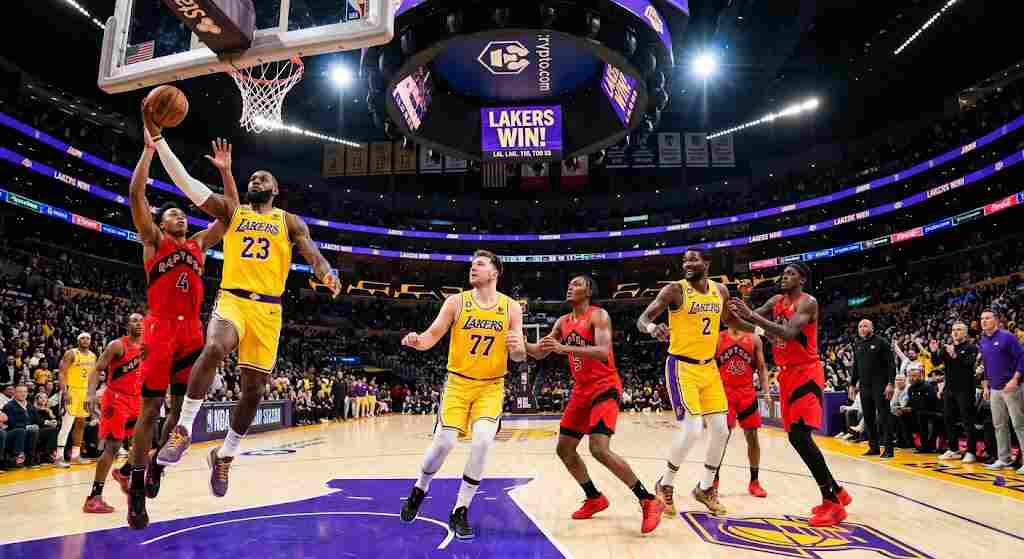
The Toronto Raptors vs Lakers match player stats from this latest NBA showdown reveal exactly how Los Angeles secured a convincing victory. When the final buzzer sounded at Crypto.com.
Arena, the Lakers had snapped out of their mid-season funk behind vintage performances from their star duo, handing the Raptors a 110-93 defeat that highlighted significant statistical disparities between the two teams.
Match Overview
| Information | Match Details |
| Event | NBA Regular Season 2025-26 |
| Game | Toronto Raptors vs Los Angeles Lakers |
| Date | January 18, 2026 |
| Venue | Crypto.com Arena, Los Angeles, California |
| Attendance | 18,997 |
| Winner | Los Angeles Lakers |
| Final Score | Lakers 110, Raptors 93 |
| Broadcast | National and Regional Sports Networks |
The Lakers improved to 25-16 on the season while the Raptors fell to 25-19. Los Angeles won for just the second time in seven games, playing their final home contest before an eight-game road trip.
Core Match Statistics Overview
Analyzing the Toronto Raptors vs Lakers match player stats reveals clear statistical advantages that determined the outcome:
| Metric | Toronto Raptors | Los Angeles Lakers |
| Field Goals % | 41.8% (38-91) | 47.3% (44-93) |
| 3PT % | 21.9% (7-32) | 36.0% (9-25) |
| Free Throws % | 66.7% (10-15) | 81.6% (13-16) |
| Total Rebounds | 43 | 48 |
| Assists | 30 | 29 |
| Turnovers | 9 | 11 |
| Steals | 7 | 8 |
| Blocks | 5 | 4 |
Three-Point Shooting Disparity
- The Raptors connected on just 7 of 32 attempts from beyond the arc (21.9%), a season-worst efficiency that crippled their offensive spacing and made their offensive sets predictable.
- Luka Doncic alone matched Toronto’s three-point output with five triples, shooting 5-of-10 from deep, demonstrating the individual brilliance that separated these two teams.
Ball Movement and Efficiency
- Toronto recorded 30 assists on 38 made field goals, demonstrating unselfish play that kept them competitive through three quarters of action.
- The Lakers posted a superior effective field goal percentage of 56.5% compared to Toronto’s 45.6%, highlighting their ability to generate higher-quality looks throughout the contest.
Paint Domination
- Deandre Ayton’s perfect 10-of-10 shooting night anchored the Lakers’ interior presence, contributing to their 48 total rebounds and preventing Toronto from establishing any inside presence.
- Toronto’s Collin Murray-Boyles (5-of-7) and Sandro Mamukelashvili (8-of-12) provided efficient bench scoring but couldn’t match Ayton’s dominance on the glass and in the paint.
Period-by-Period Analysis
| Quarter | Toronto Raptors | Los Angeles Lakers |
| Q1 | 30 | 23 |
| Q2 | 24 | 32 |
| Q3 | 26 | 32 |
| Q4 | 13 | 23 |
| Total | 93 | 110 |
First Quarter – Raptors Strike First: Toronto jumped out to a 30-23 lead behind Scottie Barnes’ aggressive play, capitalizing on early Laker miscues and building confidence on the road. The Raptors’ ball movement created open looks that they converted at a high rate.
- Second Quarter – Lakers Flip the Script: Los Angeles responded with a 32-24 frame, with LeBron James and Luka Doncic finding their rhythm. The Lakers’ defensive intensity forced Toronto into difficult shots, erasing the early deficit and establishing control heading into halftime.
- Third Quarter – Separation Achieved: The Lakers extended their lead with another 32-26 quarter, punishing Toronto’s defensive breakdowns. Deandre Ayton’s interior dominance became increasingly apparent as the Raptors had no answer for his size and efficiency around the basket.
- Fourth Quarter – Raptors Collapse: Toronto managed just 13 points in the final frame while the Lakers cruised with 23. A 9-0 Lakers run that included 3.5 scoreless minutes for Toronto sealed the outcome and highlighted the Raptors’ inability to execute in crucial moments.
Toronto Raptors Player Statistics
Scottie Barnes – 35:15 MIN
| Points | Rebounds | Assists | Steals | Blocks | FG% |
| 22 | 9 | 3 | 1 | 0 | 47.6% (10-21) |
Barnes was Toronto’s most consistent offensive threat, attacking the rim effectively and grabbing nine rebounds. His inability to stretch the floor (0-2 from three) allowed the Lakers to pack the paint in critical moments, limiting Toronto’s offensive versatility.
Brandon Ingram – 34:00 MIN
| Points | Rebounds | Assists | Steals | Blocks | FG% |
| 19 | 6 | 7 | 3 | 1 | 36.8% (7-19) |
Ingram’s return to Los Angeles was bittersweet. He contributed across the box score with seven assists and three steals, but his inefficient shooting (2-of-7 from three) prevented Toronto from gaining traction when they needed baskets most.
Collin Murray-Boyles – 24:38 MIN
| Points | Rebounds | Assists | Steals | Blocks | FG% |
| 11 | 7 | 5 | 0 | 3 | 71.4% (5-7) |
Murray-Boyles provided a spark off the bench with efficient interior scoring and three blocks. His +16.2 game score was among the highest on the team, suggesting his impact exceeded his raw point total and gave Toronto a lift during bench minutes.
Sandro Mamukelashvili – 24:24 MIN
| Points | Rebounds | Assists | Steals | Blocks | FG% |
| 20 | 6 | 2 | 1 | 1 | 66.7% (8-12) |
Mamukelashvili was a bright spot for Toronto, scoring 20 points on highly efficient shooting including 2-of-5 from three. His bench production kept the Raptors within striking distance through three quarters and provided a much-needed offensive spark.
Immanuel Quickley – 28:33 MIN
| Points | Rebounds | Assists | Steals | Blocks | FG% |
| 9 | 3 | 7 | 1 | 0 | 44.4% (4-9) |
Quickley facilitated effectively with seven assists but struggled to score, managing just nine points on limited attempts. His -11 plus/minus reflected Toronto’s struggles when he was on the floor despite his playmaking contributions.
Los Angeles Lakers Player Statistics
Luka Doncic – 32 MIN
| Points | Rebounds | Assists | Steals | Blocks | FG% |
| 25 | 4 | 7 | 2 | 0 | 47.1% (8-17) |
Doncic returned from a one-game absence to deliver a vintage performance, knocking down five three-pointers and orchestrating the Lakers’ offense with precision. His 12th technical foul of the season was a minor blemish on an otherwise dominant night where he controlled the game’s tempo.
LeBron James – 32 MIN
| Points | Rebounds | Assists | Steals | Blocks | FG% |
| 24 | 4 | 7 | 0 | 2 | 52.9% (9-17) |
The 41-year-old superstar played in back-to-back games for just the second time this season, completing a grueling stretch of five games in seven days. His consecutive buckets to open the fourth quarter sparked the decisive 91-80 lead and demonstrated why he remains one of the game’s premier closers.
Deandre Ayton – 33 MIN
| Points | Rebounds | Assists | Steals | Blocks | FG% |
| 25 | 13 | 0 | 0 | 1 | 100% (10-10) |
Ayton’s return from a knee injury was nothing short of spectacular. He recorded his highest-scoring performance since November 3 while making all 10 of his field goal attempts. His 13 rebounds anchored the Lakers’ 48-43 rebounding advantage and provided a dominant interior presence that Toronto simply couldn’t handle.
Austin Reaves – 30 MIN
| Points | Rebounds | Assists | Steals | Blocks | FG% |
| 14 | 3 | 5 | 0 | 0 | 46.2% (6-13) |
Reaves contributed solid minutes off the bench with efficient scoring and playmaking. His ability to space the floor and make timely baskets prevented Toronto from focusing entirely on the Lakers’ stars.
Statistical Leaders Summary Table
| Category | Toronto Raptors | Los Angeles Lakers |
| Leading Scorer | Scottie Barnes (22) | Luka Doncic (25) |
| Second Leading Scorer | Sandro Mamukelashvili (20) | Deandre Ayton (25) |
| Top Rebounder | Scottie Barnes (9) | Deandre Ayton (13) |
| Most Assists | Brandon Ingram (7) | Luka Doncic (7) |
| Most Steals | Brandon Ingram (3) | Luka Doncic (2) |
| Most Blocks | Collin Murray-Boyles (3) | LeBron James (2) |
Why the Lakers Won
Dominant Interior Presence
Deandre Ayton’s perfect shooting night (10-10) gave the Lakers an unstoppable force inside. Toronto’s frontcourt had no answer for his size and efficiency, as he outrebounded every Raptor while scoring at will.
The Lakers’ ability to feed Ayton in the post created open looks for their perimeter shooters and collapsed Toronto’s defense.
| Metric | Ayton | Raptors Starting Frontcourt |
| FG% | 100% | 54.8% |
| Rebounds | 13 | 16 |
| Points | 25 | 24 |
Star Power Execution
Doncic and James combined for 49 points, 14 assists, and four steals while shooting efficiently from the field. Their ability to create shots for themselves and others in critical moments—particularly the fourth-quarter surge—separated the Lakers from a Raptors team that lacked a closing closer. The Lakers’ star duo consistently made the right decisions in high-leverage situations.
Defensive Adjustments After Q1
After allowing 30 first-quarter points, the Lakers tightened their defense, holding Toronto to 63 points over the final three quarters. They forced the Raptors into difficult three-point attempts (7-of-32) and limited transition opportunities by getting back in defensive transition. The defensive intensity from Doncic and James set the tone for the entire team.
Three-Point Efficiency Gap
The Lakers’ 36% three-point shooting compared to Toronto’s 21.9% created a 24-point differential from beyond the arc. This statistical advantage allowed the Lakers to space the floor effectively while Toronto’s offense became predictable and stagnant as the game progressed.
Why the Raptors Lost
Fourth-Quarter Collapse
Toronto scored just 13 points in the final frame while the Lakers poured in 23. A 3.5-minute scoreless drought during a 9-0 Lakers run effectively ended any comeback hopes. The Raptors’ offense became stagnant and forced, resulting in poor shot selection and empty possessions.
| Quarter | Raptors Points | Lakers Points |
| Q4 | 13 | 23 |
Abysmal Three-Point Shooting
The Raptors shot 21.9% from beyond the arc (7-of-32), including 0-of-3 from Ochai Agbaji and 0-of-2 from Scottie Barnes. This lack of outside shooting allowed the Lakers to pack the paint and limit driving lanes, making Toronto’s offense one-dimensional and easier to defend.
Inability to Contain Ayton
Toronto had no defensive answer for Deandre Ayton, who made all 10 of his shots and grabbed 13 rebounds. The Raptors’ big men were consistently outmatched in the post, leading to easy baskets and second-chance opportunities. This interior dominance negated Toronto’s otherwise solid defensive efforts on the perimeter.
Over-reliance on Inefficient Mid-Range
Despite recording 30 assists, the Raptors settled for difficult mid-range attempts when their three-pointers weren’t falling. Their 41.8% field goal percentage reflects poor shot selection and an inability to generate high-quality looks against a disciplined Lakers defense.
Historical Context & Advanced Insights
Season Series Breakdown
| Date | Venue | Result |
| December 4, 2025 | Toronto | Lakers 123-93 |
| January 18, 2026 | Los Angeles | Lakers 110-93 |
The Lakers completed a season sweep of the Raptors, winning both matchups by an average margin of 23.5 points. This dominance underscores the significant gap between the two teams when both are at full strength and highlights the Lakers’ superiority in executing their game plan.
Advanced Statistical Insights
Assist-to-Field Goal Ratio: Toronto recorded 30 assists on 38 made field goals (78.9%), a remarkably high rate that typically correlates with winning basketball.
However, their poor shooting efficiency (41.8% FG, 21.9% 3PT) rendered their ball movement ineffective, proving that quality of shots matters more than quantity of passes.
Effective Field Goal Percentage: The Lakers’ eFG% of 56.5% dwarfed Toronto’s 45.6%, a difference of nearly 11 percentage points. This gap explains why the Lakers scored 17 more points despite similar possession counts (96.1 pace for both teams). The Lakers generated higher-quality looks by attacking the paint and moving the ball to open shooters.
Offensive Rating: Los Angeles posted an offensive rating of 114.5 compared to Toronto’s 96.8. The Lakers generated nearly 18 more points per 100 possessions, a testament to their superior shot quality and execution. This efficiency differential proved insurmountable for the Raptors despite their ball movement and lower turnover rate.
Turnover Battle: Toronto committed just nine turnovers (9.3% turnover rate) compared to the Lakers’ 11 (14.0%). Despite protecting the ball better, the Raptors couldn’t overcome their shooting inefficiency—a rare case where turnover advantage didn’t translate to victory. This highlights that ball security alone cannot compensate for poor shooting.
Points in the Paint: The Lakers dominated inside with 54 points in the paint compared to Toronto’s 42. This 12-point differential, combined with Ayton’s perfect shooting, established the Lakers’ interior superiority as the game’s decisive factor.
Game Implications & Key Lessons
What This Means for the Lakers
- The win snapped a 2-5 stretch and provided crucial momentum before an eight-game road trip, potentially salvaging their January schedule.
- Deandre Ayton’s return to form (25 points, 13 rebounds, 10-10 shooting) gives the Lakers a legitimate third scoring option alongside Doncic and James, making their offense significantly more difficult to defend.
- LeBron James’ ability to play back-to-back games at age 41 suggests his conditioning is peaking at the right time, which bodes well for the Lakers’ championship aspirations.
What This Means for the Raptors
- Back-to-back losses for the first time in four weeks raise concerns about Toronto’s consistency and their ability to compete with elite Western Conference teams.
- The Raptors’ three-point shooting (21.9%) must improve dramatically if they hope to make playoff noise in a competitive Eastern Conference.
- Toronto’s inability to close games—scoring just 13 fourth-quarter points—exposes a lack of a reliable go-to scorer in crunch time, an issue that must be addressed before the trade deadline.
Key Lessons
- Efficiency trumps volume: The Lakers’ superior shooting efficiency (56.5% eFG%) outweighed Toronto’s assist numbers and lower turnover rate, proving that quality of shots matters more than quantity of passes.
- Interior dominance wins games: Deandre Ayton’s perfect shooting night demonstrates how a dominant big man can single-handedly shift a game’s outcome and dictate defensive schemes.
- Three-point shooting is non-negotiable: Toronto’s 7-of-32 performance from deep made them one-dimensional and predictable, allowing the Lakers to defend with greater freedom.
- Star power matters in the fourth quarter: Doncic and James combined to close the game while Toronto’s stars faded, highlighting the importance of having elite closers in tight games.
- Bench production can’t replace starting efficiency: Despite 20 points from Mamukelashvili, Toronto’s starters shot poorly overall, making it impossible to overcome the Lakers’ balanced attack.
- Momentum swings are costly: The Lakers’ 9-0 run with Toronto scoreless for 3.5 minutes in the fourth quarter was the game’s defining stretch and showcases how quickly momentum can shift in the NBA.
Frequently Asked Questions
Who won the Toronto Raptors vs Lakers game on January 18, 2026?
The Los Angeles Lakers defeated the Toronto Raptors 110-93 at Crypto.com Arena in Los Angeles. The Lakers improved to 25-16 while the Raptors fell to 25-19.
What were Luka Doncic’s stats in the Toronto Raptors vs Lakers matchup?
Luka Doncic recorded 25 points, seven assists, four rebounds, and two steals while shooting 5-of-10 from three-point range in 32 minutes of action.
What were LeBron James’ stats in the Raptors vs Lakers game?
LeBron James finished with 24 points, seven assists, four rebounds, and two blocks on 9-of-17 shooting, playing in back-to-back games for only the second time this season.
What were Scottie Barnes’ stats for Toronto in this matchup?
Scottie Barnes led the Raptors with 22 points and nine rebounds on 10-of-21 shooting, playing 35 minutes and serving as Toronto’s primary offensive threat.
How did Deandre Ayton perform in his return from injury?
Deandre Ayton was spectacular in his return, posting 25 points and 13 rebounds while making all 10 of his field goal attempts in 33 minutes of action.
What was the Raptors’ three-point shooting percentage in this game?
The Raptors shot just 21.9% from three-point range, making only 7 of 32 attempts, which proved to be one of the deciding factors in their defeat.
Did the Lakers complete the season series sweep of the Raptors?
Yes, the Lakers swept the season series 2-0, winning 123-93 in Toronto on December 4, 2025, and 110-93 in Los Angeles on January 18, 2026.
Conclusion
The Toronto Raptors vs Lakers match player stats tell a story of star power, efficiency, and momentum. While the Raptors demonstrated commendable ball movement with 30 assists and protected the ball well with only nine turnovers, their abysmal three-point shooting (21.9%) and fourth-quarter collapse (13 points) proved fatal against a Lakers team that executed with precision when it mattered most.
Deandre Ayton’s perfect shooting night, combined with Luka Doncic and LeBron James combining for 49 points and 14 assists, showcased the Lakers’ championship-caliber ceiling when their stars align.
For Toronto, the loss exposed persistent vulnerabilities—particularly their reliance on mid-range efficiency and inability to generate consistent perimeter offense—that must be addressed if they hope to make noise in the Eastern Conference playoffs.
Ultimately, the Toronto Raptors vs Lakers match player stats reaffirm that in the modern NBA, efficiency and star-powered execution in critical moments outweigh ball movement and defensive effort alone.
The Lakers’ 56.5% effective field goal percentage and 17-point victory margin serve as a masterclass in offensive efficiency, demonstrating that when championship-caliber teams find their rhythm, they become nearly impossible to stop.
The Raptors will need to address their perimeter shooting and late-game execution if they hope to compete at the highest level, while the Lakers can build upon this statement victory as they prepare for their challenging road trip ahead.