The Lead:
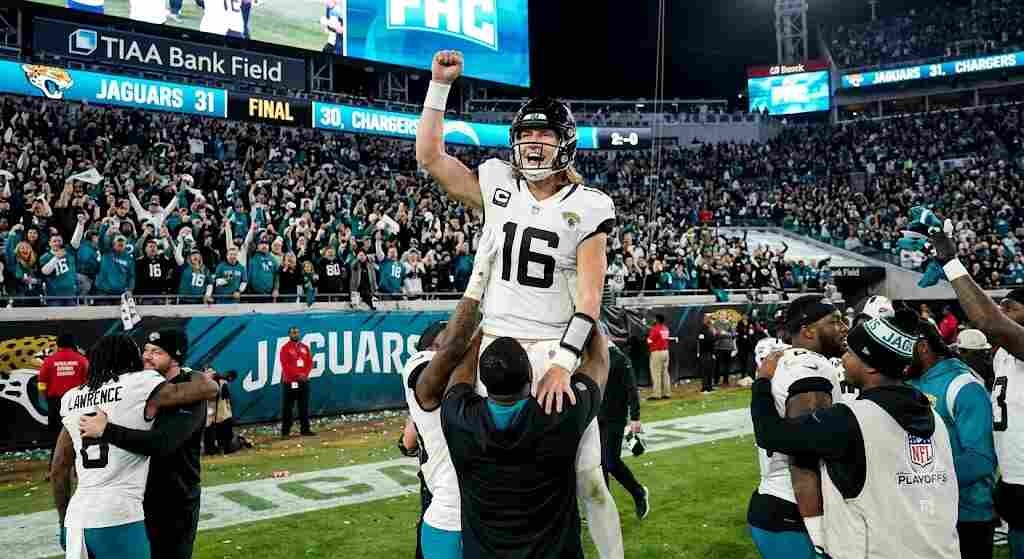
On Saturday night, January 14, 2023, the Jacksonville Jaguars hosted the Los Angeles Chargers in an AFC Wild Card playoff showdown at TIAA Bank Field in front of 70,250 roaring fans.Chargers vs Jacksonville Jaguars Match Player Stats
The Chargers jumped out to a stunning 27-0 lead in the first half, powered by three Austin Ekeler touchdowns and a Gerald Everett receiving score, while the Jaguars turned the ball over five times—including four interceptions by Trevor Lawrence.What followed was one of the most improbable turnarounds in NFL postseason history.
Lawrence, who became the third quarterback in the Super Bowl era to throw four interceptions in the first half of a playoff game, responded with four touchdown passes in the second half. Riley Patterson’s 36-yard field goal as time expired capped a 27-point comeback, the largest in franchise history and the third-largest in playoff history, giving the Jaguars a 31-30 victory.
Match Overview Table
| Information | Match Details |
| Event | AFC Wild Card Playoffs |
| Game | Los Angeles Chargers vs Jacksonville Jaguars |
| Date | January 14, 2023 |
| Venue | TIAA Bank Field, Jacksonville, Florida |
| Attendance | 70,250 |
| Winner | Jacksonville Jaguars |
| Final Score | 31-30 |
| Broadcast | NBC |
Core Match Statistics Overview
Team Stats Table:
| Metric | Los Angeles Chargers | Jacksonville Jaguars |
| First Downs | 18 | 24 |
| Total Yards | 320 | 390 |
| Rushing Yards (Att-TD) | 67 (23-2) | 117 (21-0) |
| Passing Yards (Net) | 253 | 273 |
| Comp-Att-TD-INT | 25-43-1-0 | 28-47-4-4 |
| Sacks Allowed | 3 | 2 |
| Turnovers | 0 | 5 |
| Penalties-Yards | 7-42 | 3-30 |
| Third Down Conversion | 8-17 (47.1%) | 2-10 (20.0%) |
| Time of Possession | 32:39 | 27:21 |
Turnover Differential
- The Chargers committed zero turnovers while forcing five Jaguars turnovers, yet still lost—becoming the first team in the Super Bowl era to lose a playoff game with a turnover differential of +5 or better.
- Jacksonville became the first team in Super Bowl history to win a playoff game with a turnover differential of minus-five or worse, overcoming a deficit that had been 0-19.
Total Yardage Disparity
- The Jaguars out-gained the Chargers 390 to 320 in total offense, with Travis Etienne’s 109 rushing yards providing a ground game that the Chargers couldn’t contain.
- Despite the Chargers’ efficient passing attack (273 yards, 1 TD, 0 INT), they couldn’t sustain drives in the second half, managing just three points after halftime.
Third Down Inefficiency
- Jacksonville converted only 2 of 10 third-down attempts (20%), yet still scored 31 points—a testament to their big-play ability and success on fourth down (2-of-3).
- The Chargers converted 8 of 17 third downs but failed to put the game away, settling for field goals instead of touchdowns in critical red-zone situations.
Period-by-Period Analysis
| Period | Los Angeles Chargers | Jacksonville Jaguars |
| 1st Quarter | 17 | 0 |
| 2nd Quarter | 10 | 7 |
| 3rd Quarter | 3 | 13 |
| 4th Quarter | 0 | 11 |
| Final | 30 | 31 |
1st Quarter: Chargers Blitz Early
- Austin Ekeler scored on runs of 13 and 6 yards, while Cameron Dicker added a 22-yard field goal, giving the Chargers a 17-0 lead.
- Trevor Lawrence threw two interceptions in the quarter, including one to Drue Tranquill on the second play of the game that set up Ekeler’s first touchdown.
2nd Quarter: Jaguars Show Life Before Half
- Gerald Everett’s 9-yard touchdown reception from Justin Herbert pushed the lead to 24-0. Dicker’s 23-yard field goal made it 27-0.
- Lawrence finally connected with Evan Engram for a 9-yard touchdown with 24 seconds left in the half, cutting the deficit to 27-7 and giving Jacksonville a glimmer of hope.
3rd Quarter: Jaguars Mount the Comeback
- Lawrence found Marvin Jones for a 6-yard touchdown, making it 27-14. Dicker answered with a 50-yard field goal for the Chargers, pushing the lead back to 30-14.
- Lawrence then hit Zay Jones for a 39-yard touchdown, but the two-point conversion failed, leaving the score 30-20 entering the fourth.
4th Quarter: The Miracle Finish
- Christian Kirk caught a 9-yard touchdown pass from Lawrence, who then ran in the two-point conversion to make it 30-28 with 5:25 remaining.
- The Jaguars’ defense forced a punt, and Lawrence engineered the game-winning drive, highlighted by Travis Etienne’s 25-yard run on fourth-and-1. Patterson’s 36-yard field goal as time expired sealed the 31-30 victory.
Detailed Team Player Statistics
Los Angeles Chargers Player Statistics
| Player | Passing | Rushing | Receiving | Notes |
| Justin Herbert | 25/43, 273 YDS, 1 TD, 0 INT, 84.7 RTG | 3 ATT, 12 YDS | — | Efficient but couldn’t sustain second-half drives |
| Austin Ekeler | — | 13 ATT, 35 YDS, 2 TD | 2 REC, 8 YDS | Carried the offense early with two first-half touchdowns |
| Gerald Everett | — | — | 6 REC, 109 YDS, 1 TD | Led the Chargers in receiving yards; caught the 9-yard TD |
| Keenan Allen | — | — | 6 REC, 61 YDS | Leading target but limited to short-to-intermediate routes |
Impact Summary: Justin Herbert’s Chargers vs Jaguars player stats line was solid—273 yards, one touchdown, and no interceptions—but the offense stagnated in the second half, managing just three points after the break.
Austin Ekeler’s two touchdowns gave the Chargers their early cushion, but the rushing attack (67 total yards) couldn’t close out the game. Gerald Everett’s 109 receiving yards were a bright spot, but the Chargers’ inability to convert red-zone opportunities into touchdowns ultimately cost them.
Jacksonville Jaguars Player Statistics
| Player | Passing | Rushing | Receiving | Notes |
| Trevor Lawrence | 28/47, 288 YDS, 4 TD, 4 INT, 70.2 RTG | 1 ATT, 8 YDS | — | Overcame four first-half INTs with four second-half TDs |
| Travis Etienne Jr. | — | 20 ATT, 109 YDS, 0 TD | 1 REC, 12 YDS | Key 25-yard run on fourth-and-1 set up winning field goal |
| Evan Engram | — | — | 7 REC, 93 YDS, 1 TD | Led Jaguars in receiving yards; caught the first TD before half |
| Christian Kirk | — | — | 8 REC, 78 YDS, 1 TD | Caught the go-ahead touchdown with 5:25 remaining |
| Zay Jones | — | — | 8 REC, 74 YDS, 1 TD | Had the 39-yard touchdown in the third quarter |
Impact Summary: Trevor Lawrence’s Chargers vs Jaguars match player stats tell a tale of two halves—four interceptions in the first, four touchdowns in the second. His 288-yard, 4-TD performance ranks among the greatest playoff comebacks in NFL history. Travis Etienne provided a steady ground presence with 109 rushing yards, while the receiving trio of Engram, Kirk, and Zay Jones combined for 23 catches, 245 yards, and three touchdowns.
Statistical Leaders Summary Table
| Category | Los Angeles Chargers | Jacksonville Jaguars |
| Leading Scorer | Austin Ekeler (12 PTS – 2 TD) | Christian Kirk (6 PTS – 1 TD) |
| Second Leading Scorer | Cameron Dicker (9 PTS – 3 FG) | Evan Engram (6 PTS – 1 TD) |
| Top Passer | Justin Herbert (273 YDS, 1 TD, 0 INT) | Trevor Lawrence (288 YDS, 4 TD, 4 INT) |
| Top Rusher | Austin Ekeler (35 YDS, 2 TD) | Travis Etienne (109 YDS, 0 TD) |
| Top Receiver | Gerald Everett (109 YDS, 1 TD) | Evan Engram (93 YDS, 1 TD) |
| Defensive Leader | Asante Samuel Jr. (3 INT, 6 PD) | Foyesade Oluokun (9 tackles) |
Analytical Breakdowns (“Why They Won / Why They Lost”)
Why the Jacksonville Jaguars Won
Unshakable Quarterback Resilience
Trevor Lawrence’s Chargers vs Jaguars player stats after halftime were staggering: 4 touchdowns, 0 interceptions, and a 118.4 passer rating in the second half. He shook off four first-half interceptions—half of what he threw in the entire regular season—to deliver one of the greatest playoff performances ever.
| Half | Comp-Att | Yards | TD-INT | Rating |
| First Half | 10/23 | 101 | 0-4 | 19.9 |
| Second Half | 18/24 | 187 | 4-0 | 135.2 |
Ground Game Control
Travis Etienne’s 109 rushing yards on 20 carries gave the Jaguars offensive balance and allowed them to control the clock when it mattered most. His 25-yard run on fourth-and-1 with under two minutes remaining was the defining play of the game.
| Rusher | Att | Yds | Avg | Long |
| Travis Etienne | 20 | 109 | 5.5 | 25 |
| Chargers RBs (Ekeler+Kelley) | 20 | 55 | 2.8 | 13 |
Big-Play Passing Attack
Lawrence connected on four touchdown passes to four different receivers—Engram, Marvin Jones, Zay Jones, and Kirk—spreading the ball and keeping the Chargers’ defense off balance. The Jaguars averaged 7.5 yards per pass attempt in the second half.
Why the Los Angeles Chargers Lost
Inability to Close
The Chargers scored 27 points in the first half but managed only three points after halftime. Their offense went three-and-out on four of their six second-half possessions, failing to sustain drives and allowing the Jaguars to climb back.
| Half | Points | First Downs | Time of Possession |
| Chargers 1st Half | 27 | 12 | 18:42 |
| Chargers 2nd Half | 3 | 6 | 13:57 |
Heavy Dependence on Two Players
Austin Ekeler accounted for both Chargers touchdowns, and Gerald Everett was the only receiver to surpass 60 yards. Keenan Allen and Josh Palmer were largely neutralized, combining for just 8 catches and 92 yards. The Chargers’ offense lacked a third option to step up when the Jaguars adjusted.
Costly Penalty and Missed Field Goal
Travon Walker’s unnecessary roughness penalty extended a Chargers drive, but Cameron Dicker missed a 40-yard field goal that would have made it a two-score game. That miss proved pivotal, as the Jaguars scored the go-ahead touchdown on their next possession.
Historical Context & Advanced Insights
Season Series Breakdown
These two teams met only once during the 2022 regular season, with the Chargers winning 38-10 in Week 3. The playoff rematch flipped the script entirely.
| Date | Matchup | Result |
| Sep 25, 2022 | Jaguars @ Chargers | Chargers 38, Jaguars 10 |
| Jan 14, 2023 | Chargers @ Jaguars (Playoffs) | Jaguars 31, Chargers 30 |
Advanced Statistical Insights
Assist-to-Field-Goal Ratio and Efficiency
The Chargers’ offense was built on efficiency—no turnovers, 273 passing yards, and 8-of-17 on third down—but they settled for field goals instead of touchdowns in critical moments. Cameron Dicker’s three field goals were a sign of offensive stagnation rather than efficiency. The Jaguars, despite converting only 2-of-10 third downs, scored touchdowns on four of their five red-zone trips, maximizing their limited opportunities.
Turnover Differential Paradox
The Chargers finished plus-five in turnover differential (0 turnovers forced, 5 takeaways), yet lost. This was historically unprecedented: entering this game, teams with a turnover differential of +5 or better in the playoffs were 19-0.
The Chargers became the first team to lose under those conditions, illustrating that turnovers alone don’t guarantee victory—you must also score points off them. The Chargers scored only 17 points off five Jaguars turnovers, leaving too many points on the field.
Possession and Passer Rating Correlation
Despite a higher passer rating (84.7 vs. 70.2) and more time of possession (32:39 vs. 27:21), Herbert’s Chargers vs Jaguars match player stats couldn’t prevent the collapse. Lawrence’s lower overall rating was dragged down by his first-half interceptions; his second-half rating of 135.2 was the difference-maker.
Game Implications & Key Lessons
What This Means for Jacksonville Jaguars
- This victory validated Doug Pederson’s coaching and Trevor Lawrence’s development as a franchise quarterback capable of overcoming catastrophic adversity.
- The Jaguars advanced to the Divisional Round for the first time since 2017, building momentum for a franchise that had won just four games combined in the previous two seasons.
- The win established a new standard of belief in Jacksonville—the team had won five straight home games, all in come-from-behind fashion.
What This Means for Los Angeles Chargers
- The loss exposed a recurring inability to close out games, leading to the firing of offensive coordinator Joe Lombardi.
- Brandon Staley’s coaching decisions came under intense scrutiny, particularly the conservative play-calling in the second half that allowed the Jaguars to stay within striking distance.
- The Chargers must address their red-zone efficiency—settling for field goals instead of touchdowns was the difference between victory and defeat.
Key Lessons
- Never count out a quarterback with belief: Trevor Lawrence’s confidence never wavered despite four interceptions, proving that mental toughness can overcome statistical disaster.
- Turnovers are not everything: A plus-five turnover differential is usually a guaranteed win, but the Chargers proved that failing to capitalize on turnovers can be fatal.
- Momentum is real: The Jaguars scored 31 unanswered points after falling behind 27-0, showing how quickly momentum can shift in the playoffs.
- Fourth-down aggression pays off: The Jaguars converted two of three fourth-down attempts, including the game-winning drive’s 25-yard run on fourth-and-1.
- Red-zone efficiency wins championships: The Jaguars scored touchdowns on four of five red-zone trips; the Chargers settled for field goals too often.
- Defensive adjustments matter: After allowing 27 first-half points, the Jaguars’ defense held the Chargers to just three points and 145 total yards in the second half.
FAQ & Conclusion
Frequently Asked Questions
Who won the Chargers vs Jaguars playoff game?
The Jacksonville Jaguars defeated the Los Angeles Chargers 31-30 on January 14, 2023, in the AFC Wild Card playoffs.
What stats did Trevor Lawrence have during the Chargers vs. Jaguars game?
Trevor Lawrence completed 28 of 47 passes for 288 yards, four touchdowns, and four interceptions, with a 70.2 passer rating.
What were Justin Herbert’s stats against the Jaguars?
Justin Herbert went 25-of-43 for 273 yards, one touchdown, and no interceptions, with an 84.7 passer rating.
How did the Jaguars come back from 27-0?
Trevor Lawrence threw four touchdown passes in the second half—to Evan Engram, Marvin Jones, Zay Jones, and Christian Kirk—while the defense held the Chargers to three points after halftime.
Who scored the game-winning points for the Jaguars?
Riley Patterson kicked a 36-yard field goal as time expired to give the Jaguars a 31-30 victory.
What is the significance of this comeback?
It was the third-largest comeback in NFL playoff history, the largest in Jaguars franchise history, and the first time a team won a playoff game with a turnover differential of minus-five or worse.
Conclusion
The Chargers vs Jacksonville Jaguars match player stats tell a story of two quarterbacks heading in opposite directions. Justin Herbert delivered a clean, efficient performance—273 yards, one touchdown, no interceptions—but it wasn’t enough.
Trevor Lawrence, despite a nightmare first half with four interceptions, delivered one of the most resilient performances in playoff history with four second-half touchdowns. The Jaguars’ victory was built on big-play execution, defensive adjustments, and an unshakable belief that transcended the box score.
In the end, Jacksonville’s ability to maximize scoring opportunities and capitalize on momentum proved far more valuable than the Chargers’ statistical superiority in turnover margin and time of possession. Efficiency and teamwork overcame individual brilliance, and the Jaguars advanced to write another chapter in their improbable playoff run.